Mastering Beer Steins: Sizes & Prices Explained
Most people arrive at Oktoberfest thinking there is one beer size: the Maß. Then they notice someone at the next table with a Radler, overhear an order for a Russ’n, and wonder what they have been missing. This guide is what every first-timer should know about Wiesn beer sizes, prices, and how to pick the one that actually suits your day, at both Oktoberfest and Frühlingsfest.
Last updated April 2026. Prices reflect the 2025 Oktoberfest and Frühlingsfest seasons; expect ~3–5% annual creep.
What “Maß” Really Means
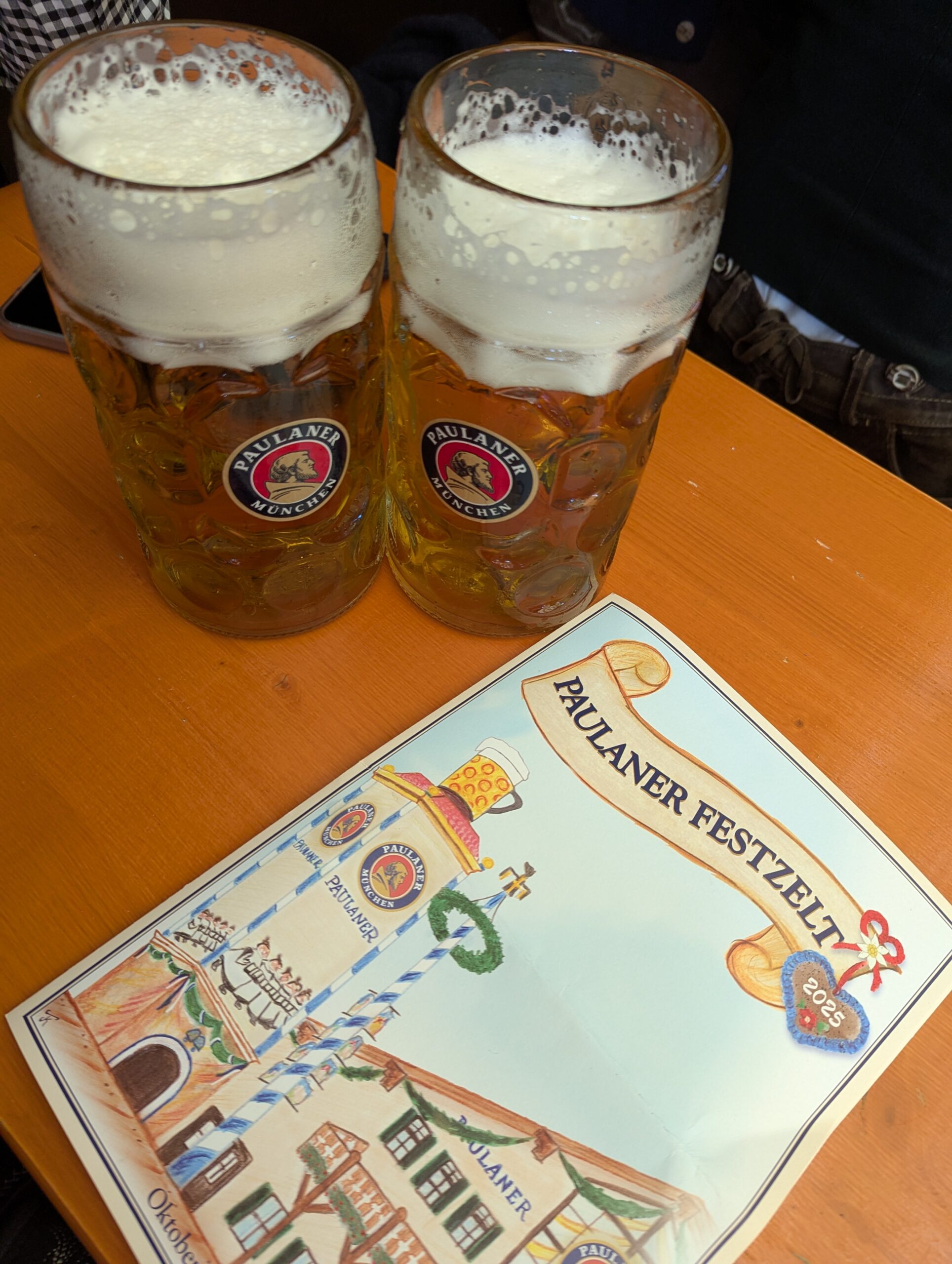
Maß (pronounced “mass”) is the classic one-litre beer stein at Oktoberfest: a heavy glass mug with a sturdy handle, and the image most international visitors already have in their head when they picture a German beer tent. Inside the big Wiesn tents it is the standard serve. Outside in beer gardens and at smaller stands you will sometimes see alternatives, but the Maß is king.
At Frühlingsfest (the spring festival on the same Theresienwiese grounds) the big tents pour the same way, but you have more flexibility outside: more half-litres, more relaxed pacing, fewer “everyone-in-unison” moments.
The detail a lot of visitors miss: Oktoberfest beer is a special Festbier brewed for the Wiesn and usually stronger than a typical Helles, often around 6% ABV. A Maß hits harder than the same volume of supermarket lager.
My rule of thumb for first-timers
If you are not used to stronger lagers and you have not eaten: do not start with a Maß. A litre of 6% Festbier on an empty stomach at 11am is the shortest day at Oktoberfest that money can buy.
The Steins and Serves You Will Actually See (and What They Cost)
The Maß (1.0 litre)
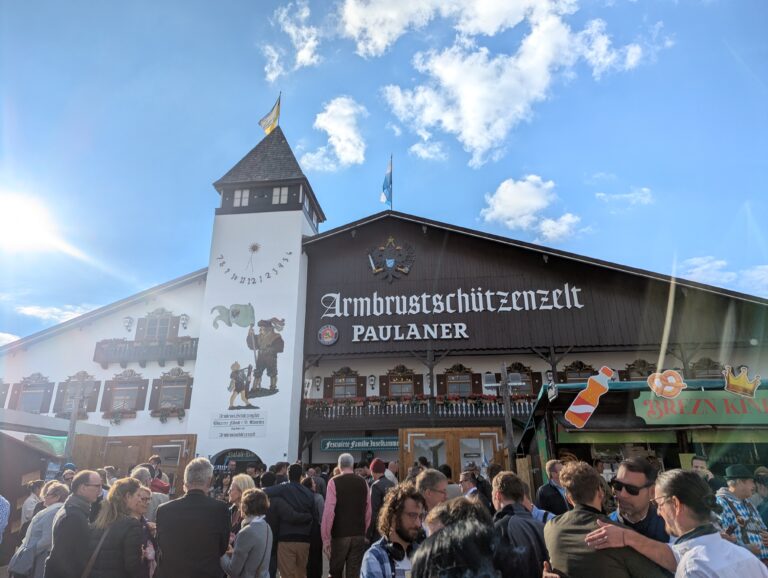
Where: Inside every big Oktoberfest tent — Augustiner-Festhalle, Hacker-Festzelt, Hofbräu-Festzelt, Schottenhamel (where the first keg is tapped by the Mayor of Munich), Paulaner, Löwenbräu, and the rest.
Price: Roughly €14–€16+ at Oktoberfest, with prices creeping up each year. Frühlingsfest tends to be noticeably cheaper: €12–€14+, depending on the tent.
When to choose it: You are sitting down, you have food on the way, and you are committing to the tent rhythm — toasts, songs, long conversations.
The Halbe (0.5 litre)
Where: This is the tricky one. Inside the big Oktoberfest tents a half-litre is uncommon; tents are geared around the Maß, and the service and table dynamic assumes you are ordering one. Outside the tents, in beer gardens and smaller stands, a Halbe is easier to find, and at Frühlingsfest it is more readily available in the outdoor areas.
Price: When available, roughly half the Maß price (not always a perfect 50%, often a touch more per ml). Plan for €7–€9 if a Maß is €15.
When to choose it: You want to taste the atmosphere without committing to a litre, or you are doing a “one beer and then rides” strategy.
Radler and Russ’n
A Radler is lager mixed roughly 50/50 with lemon soda. A Russ’n is wheat beer (Weißbier) mixed the same way. Both are milder per sip, lighter on the stomach, and a lifesaver on warm afternoons or if you are pacing for a long session.
Price: Usually the same per volume as beer, so you are not “cheating” the system on cost, just on alcohol content. Typical sizes are 0.5L or 1.0L depending on the venue.
Non-alcoholic options and Spezi
Do not underestimate these. Spezi, cola mixed with orange soda, is a Bavarian festival staple that keeps your energy up without ending your evening early. Alcohol-free beer (Alkoholfrei) is widely available and nobody looks twice.
Price: Soft drinks can surprise you. Big servings in the tents often land in the €10–€12 range. That is not a typo.
Choosing the Right Size for Your Day
Here is the decision tree I use. It is not romantic, but it keeps days from unraveling.
Step 1: Check your Grundlage
Grundlage means “foundation”. In Bavarian drinking culture it is the food in your stomach that carries you through the beer. No Grundlage? Start with food first, or start smaller. A Hendl (roast chicken) or a fat Brezn (pretzel) is the classic answer and pairs with anything you will order next.
Step 2: Set your tempo for the day
- Settled tent day: Maß fits the rhythm. You are sitting, singing, eating, staying put.
- Sampler day (tents + rides + walking): Half-portions where you can find them, or alternate with a Radler or a Spezi.
- First hour on the grounds: Water or Spezi first, then beer. Even for regulars.
Step 3: Do the budget math honestly
Two Maß at Oktoberfest clear €30+ before tip. Add food (€15–€25) and you are at €50–€60 for a perfectly standard couple of hours. If you are trying to keep the tab sane, plan one Maß as your “main event” and fill around it with food, rides, and a non-alcoholic drink. You will enjoy the atmosphere longer and leave with money for the train.
Where Your Maß Feels Worth It: Tent Notes
Every Wiesn tent is fun, but they feel different, and how you drink should match the room. A few honest notes from someone who has carried more Maßkrüge than he can count.
Augustiner-Festhalle — the classic choice
Augustiner serves from traditional wooden barrels (Holzfass), which changes how the beer pours and gives it a softer, rounder finish to my taste. If I am spending €15 on a litre, this is where I want to spend it. The room skews friendlier for mixed-age groups and first-timers who want the traditional atmosphere rather than the full party.
Hacker-Festzelt — the best “wow” interior
The famous “Himmel der Bayern” (Heaven of Bavaria) painted ceiling does real work on your mood, especially when the band hits the big sing-alongs. A Maß here can be dangerously easy to drink, so watch your pace.
Hofbräu-Festzelt — loud, international, standing-heavy
Famous internationally, and the only big tent with a real standing/dancing area in front of the band. It can be a blast. It is also where I see the most misjudgment: more standing means more wandering, more accidental extra orders, more blurry evenings. Alternate with water or Spezi if you end up here. For a read on which Wiesn tent fits your vibe, see my guide to afternoon versus evening Oktoberfest for first-timers.
Ordering Like You Mean It
You do not need perfect German. A few words help you look confident, and confident gets you served faster when the tent is slammed.
Useful phrases
- “A Maß, bitte.” — A litre, please.
- “Zwei Maß.” — Two litres. Careful what you wish for.
- “Noch a Brezn, bitte.” — Another pretzel, please. (Bavarian; High German would be “Noch ein Brezn, bitte.”)
- “Zahlen, bitte.” — The bill, please.
Practical ordering tips
- Order food early if you plan to eat. At peak, the kitchen is slower than the bar.
- Watch the band tempo. When the music speeds up, tables drink faster. Fun, until it is not.
- Do not argue about foam. German pours are regulated by volume law; you will not win that conversation.
- Have cash. Tents increasingly take card, but servers at peak move faster with cash, and speed is everything.
Tips, Deposits, and the Souvenir Stein Trap
Tipping
In the tents I round up clearly and quickly. A €15.20 Maß becomes €16. Ordering multiple drinks or getting great service at a packed table earns a bit more. The key is to say the total you are paying before handing money over. Clarity is faster than generosity.
Deposits (Pfand) outside the tents
At some stands and outdoor areas you will see a Pfand (deposit) system on cups and mugs. Return the vessel, get the deposit back. Inside the big tents this does not apply the same way; the Maßkrüge stay in the tent system.
Keeping the Maßkrug
Tourists try this every year. Do not. Security checks exits specifically for it, and “I liked the design” does not defuse the conversation. If you want a real Maßkrug to take home, buy an official souvenir version from a shop or stand near the grounds. Same weight, same look, and your evening ends the way you wanted.
Related reading: Oktoberfest Tips: Get a Seat Without Reservation · Discover the Best Times to Visit Oktoberfest
Frequently Asked Questions
How much is a Maß of beer at Oktoberfest?
Plan roughly €14–€16+ per Maß inside the big tents for the 2025 season, with prices creeping up a few percent each year. Prices vary slightly between tents; Augustiner and Hofbräu sit near the top of the range. Menus are posted at every tent entrance, so you can check before sitting down.
Can you order a half-litre (0.5L) beer in the Oktoberfest tents?
Usually not. The big tents are geared around the 1.0L Maß, and a Halbe is not consistently on offer the way it is in a normal Munich pub. You will find smaller serves more reliably at outdoor stands, in beer gardens, and at Frühlingsfest.
Is Oktoberfest beer stronger than regular beer?
Yes. Wiesn Festbier is specifically brewed for the festival and typically lands around 6% ABV, noticeably stronger than a standard Helles. That is the main reason a Maß hits harder than visitors expect, especially in the first hour before the Grundlage has caught up.
Is beer cheaper at Frühlingsfest than Oktoberfest?
Generally yes. A Maß at Frühlingsfest tends to run €12–€14+ versus €14–€16+ at Oktoberfest, depending on the tent and year. The pacing is also more relaxed, which tends to keep the rest of the tab down too.
Can I take an Oktoberfest beer stein (Maßkrug) home as a souvenir?
No. Taking a real tent Maßkrug is treated as theft, and security checks exits for it. Buy an official souvenir stein from a shop or stand near the grounds instead: cheaper than the fine and lighter than the regret.
Quick Summary
- Maß = 1 litre, the default inside the big tents. Budget €14–€16+ at Oktoberfest, €12–€14+ at Frühlingsfest (2025 season).
- Oktoberfest Festbier is ~6% ABV — stronger than a normal Helles. Eat first.
- Half-litres are not reliably available in the big Wiesn tents. Hunt for them outside or at Frühlingsfest.
- Pick the tent for the mood: Augustiner for classic (wooden barrels), Hacker for the painted ceiling and sing-alongs, Hofbräu for loud international energy.
- Radler and Spezi are your pace-keepers. Soft drinks inside the tents cost €10–€12. Not a typo.
- Do not try to keep a real Maßkrug. Buy an official souvenir version instead.
About Sepp
Servus — I’m Sepp. I’m on the Theresienwiese every September for the Wiesn and every April for the Frühlingsfest. Everything here comes from actual tent hours, not a press kit. Prost.